

Annotation_Hub
Simple, web based and pluggable Annotation Solution

Annotation_Hub
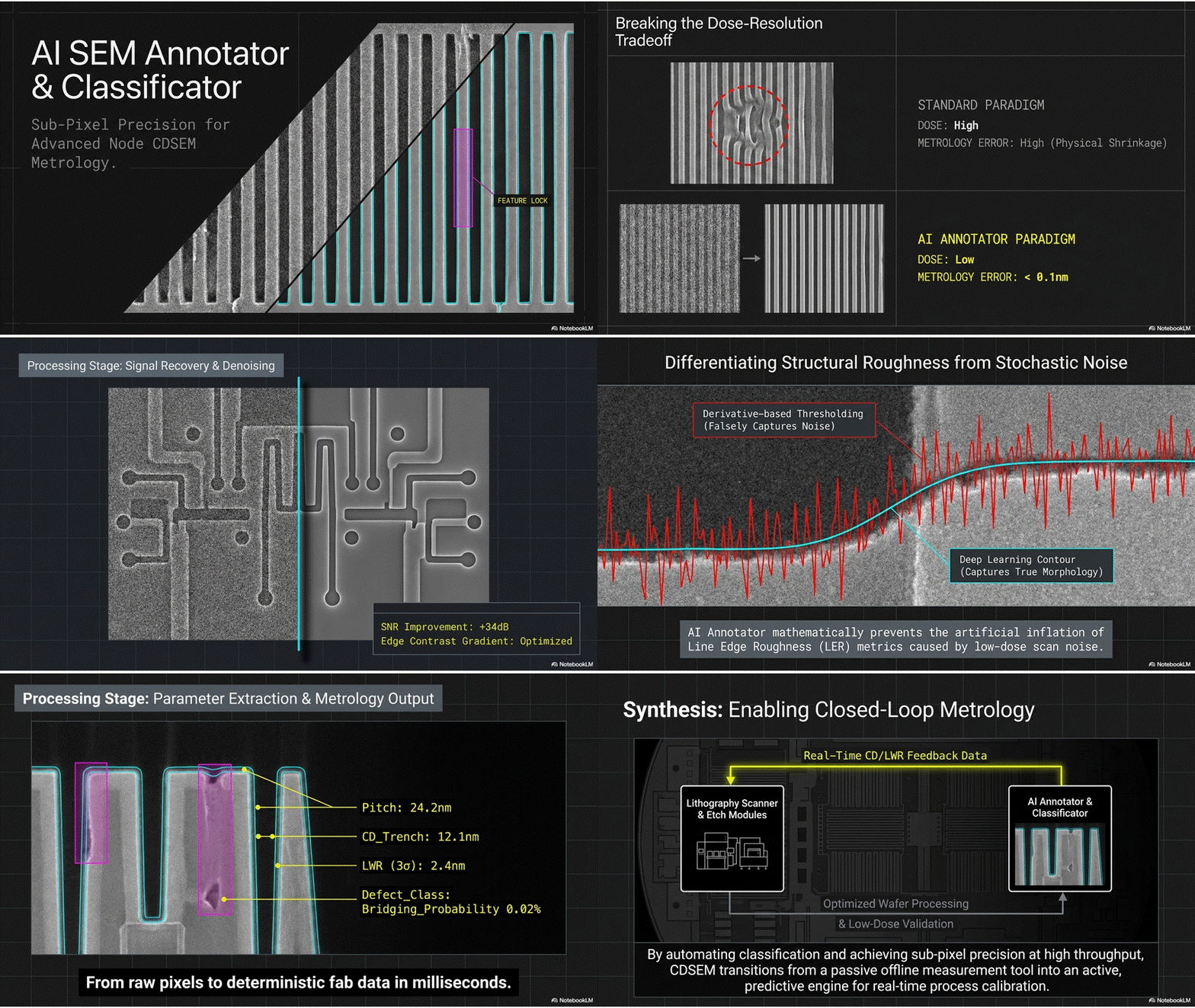
In semiconductor fabrication, Critical Dimension Scanning Electron Microscopy (CD-SEM) is the standard method for inspecting sub-10nm lines, trenches, and contact holes. However, drawing hundreds of sub-pixel bounding boxes by hand takes fifteen to thirty minutes per micrograph, creating a massive manual bottleneck. Security requirements prevent fabs from using modern cloud-based AI tools because highly sensitive micrograph data represents strictly proprietary intellectual property that cannot leave air-gapped local lab servers. Additionally, generic computer vision models fail on these images because they apply heavy shearing and perspective warping that ruins metrology aspect ratios. To solve these critical problems, the AI SEM Annotator and Classificator operates as a completely offline, air-gapped desktop suite that secures intellectual property while accelerating workflows


The Multi-Layer Metrology Pipeline
The software processes raw electron micrographs through a precise multi-layer computational architecture. In the initial processing stages, a latent space denoising layer suppresses stochastic scan noise and dramatically optimizes the edge contrast gradient. The context-aware classification layer then identifies discrete topologies, such as target vias and trench terminuses, prior to edge extraction. Next, a sub-pixel interpolation contour layer maps continuous structural boundaries completely independent of local pixel grid constraints. This five-layer system finally extracts deterministic metrology parameters like pitch, trench width, and line width roughness in milliseconds
Autonomous Target Extraction Engines
Rather than relying on tedious manual drawing, the application features an automated one-click auto-replication engine for rapid dataset curation. Users can draw just one reference bounding box around a target feature, and a multi-scale Normalized Cross-Correlation (NCC) engine combined with Non-Maximum Suppression (NMS) populates over fifty localized bounding boxes in 200 milliseconds. For automated feature extraction, the suite implements a zero-threshold topology-aware skeletonization pipeline that perfectly traces structural edges using aggressive denoising and Otsu-thresholded Canny gradients. This engine autonomously classifies bounding boxes based on boundary interactions, instantly flagging fully enclosed structures green versus border-intersecting incomplete features red. To handle extremely low signal-to-noise ratios, the extractor can dynamically load sibling SEM captures and align them using sub-pixel Phase Correlation to ensemble bounding box votes.


Physics-Informed Training and Calibration
To prevent standard deep learning augmentations from distorting delicate nanometer geometries, the local YOLOv8 training hub is upgraded with physics-informed hyperparameters. For example, setting an ultra-low shear limit of 1.5 degrees ensures that orthogonal lines and trenches do not slant into parallelograms during training. Additionally, a high box loss gain and distribution focal loss drive the optimizer to prioritize sub-pixel edge alignment over rough bounding. Custom defect copy-paste augmentations automatically multiply rare instances across clean backgrounds to maximize dataset diversity. Ultimately, this high-throughput pipeline enables closed-loop metrology by feeding real-time critical dimension feedback back to lithography scanner and etch modules for calibration

Why LVTailoring?
Same Hardware
No need for new, highly-specialized, and expensive hardware
Same System
Re-invest in the power of your business with our innovative solution
New Capabilities
Control your capital costs, solve your performance issues and achieve your goals with ease
Save your capital dollars.
Allow us to unlock the full potential of your existing tools – using the same system, same hardware , and new software - for brand new capabilities.

